
This month, we’re continuing our quarterly conversation on where designers find inspiration with Daniel Clucas, Founder and Design Director of London-based Studio ID.
Daniel has had a long and meaningful relationship with the SEKISUI KYDEX team, from his work at Acumen to his role as a Leadership Board Member of the Green Cabin Alliance alongside fellow designers Elina Kopola, Belinda Mason, and Ben Smalley, our VP – Business Development.
The Feeling That Stays With You
KM: Well, Daniel – let’s get right to it! I’m eager to hear where you draw inspiration.
DC: For me, inspiration is more than visual – it’s emotional, sensory and deeply personal. What inspires me as a designer is inseparable from what inspires me as a person. When we founded Studio ID, our mission was simple: to make things better for both people and the planet. That belief shapes every project we undertake. My desire to improve the world fundamentally influences what I create, how I create it, and ultimately what I find inspiring.
KM: What experiences have shaped you the most?
DC: The experiences from which I draw the most influence all stem back to growing up in the countryside. I have vivid memories of being immersed in nature: the sounds of the woods, the smell of the earth after rain, and the way sunlight moves through trees, constantly changing and never static. Those sensory impressions made a profound impact on me and have stayed with me ever since, despite having lived in London for nearly twenty years.
KM: Your comment instantly made me think of Komorebi, the Japanese word for sunlight filtering through the leaves of trees – one of those beautiful experiences English can describe, but somehow hasn’t managed to name! The impressions you’ve shared are so compelling that readers will surely be reminded of their own moments of being immersed in nature. Having grown up on the coast, the sound of gulls, the rhythm of the waves, and the scent of the ocean always transport me.

DC: Yes, looking back, I think that’s where my fascination with how experiences shape our perception of the world began. I’ve always felt that the best expression of that idea comes from a quote from Maya Angelou:
“I’ve learned that people will forget what you said, people will forget what you did, but people will never forget how you made them feel.”
As designers, that idea is incredibly powerful. Whether it’s the first glimpse of a product, entering a thoughtfully designed space, or spending eight hours in an aircraft cabin, what people carry with them is how it makes them feel.

KM: I always say a good flight is one where nothing unusual happens. But a great flight is one where something exceeds expectations – whether that’s a customer service agent who goes above and beyond, truly exceptional service from a flight attendant, or a carefully considered aircraft interior that makes the journey feel more thoughtful and comfortable, regardless of what class of service you’re in. Passengers may not consciously process every element shaping their experience, but they know when something feels distinctive enough to talk about. Those standout, “cocktail party-worthy” moments are what turn a flight into a positive story – and help create lasting brand loyalty.
DC: We often talk about “core memories” – moments that stay with us long after the experience itself. The film Inside Out gave the concept a name, but it’s something designers have always understood instinctively: great design has the ability to create lasting impressions. It might be an overwhelming sense of immersion, comfort or privacy. It might be a unique experience that feels unlike anything else. Or it might be something much smaller but equally meaningful – a tiny moment of delight that solves a problem before you’ve even realized you have one.
On a recent flight, my overriding memory was being woken in the middle of the night by an hour and a half of clunking from the galley behind me. Probably not the core memory the airline intended to create!
KM: No, you’re right about that! So, did your early connection to nature become the foundation of your passion for sustainability?
DC: Absolutely. I believe travel is one of humanity’s greatest forces for good. It broadens our minds, gives us perspective, allows us to see the world through other people’s eyes, and helps us experience beauty in all its forms. Yet after spending many years in aviation, I became increasingly uncomfortable with the impact our industry was having on the very environments that make travel so valuable.
For a long time, I felt I wanted to do more. The moment that transformed that feeling into action came one sunny afternoon with my son. As we stood together looking up at an aircraft passing overhead, I realized that for both his future and my own sense of responsibility, I wanted to be able to say that I had made a difference. Not that I had all the answers, but that I hadn’t simply accepted the status quo.


KM: That’s a meaningful decision, Daniel. I think many people struggle with how they can contribute to the issues we face globally.
DC: I think that’s true for all of us. No individual can solve climate change or completely reinvent the way we travel. But meaningful change rarely comes from a single breakthrough. It comes from thousands of people making thousands of better decisions and pushing in the same direction.
After sixteen years designing aircraft interiors and passenger experiences, I felt my skills could help contribute to that change. I knew that innovation and sustainability didn’t have to be separate conversations; they could be part of the same design process. That’s why Studio ID was born.
KM: You mentioned “we” earlier. Tell us more about the founding of Studio ID.
DC: My co-founder, Isabella Pourtaheri, quickly joined the journey, bringing a perspective very different from my own.
With a background in business and strategy, she approaches challenges through a completely different lens, asking questions that designers often overlook and uncovering opportunities that aren’t immediately obvious. That combination of perspectives has become one of Studio ID’s greatest strengths.
KM: How has that balance of creative and strategic thinking shaped Studio ID’s direction?
DC: By combining innovation, strategy and sustainability, we’re creating a better future for travel. Our first client, and still one of our closest partners, was Cosmic Aerospace, a visionary electric aircraft manufacturer. Working with a team driven by such passion and purpose felt like a natural fit. Together, we’ve spent the last two years exploring what it will feel like to travel in an electric aircraft and how we can create experiences that genuinely connect with people.
KM: I’m excited to learn more about your work with them — maybe a topic for a future KYDEX® designBrief!
DC: In many ways, that work brings me back to where my inspiration began: creating meaningful experiences that people remember. Experiences that engage the senses, create lasting memories and, hopefully, leave the world a little better than we found it.

KM: Thanks for sharing your perspective, Daniel, and inspiring all of us in the aviation industry to step up and do more for people and our planet.

Daniel Clucas Biography
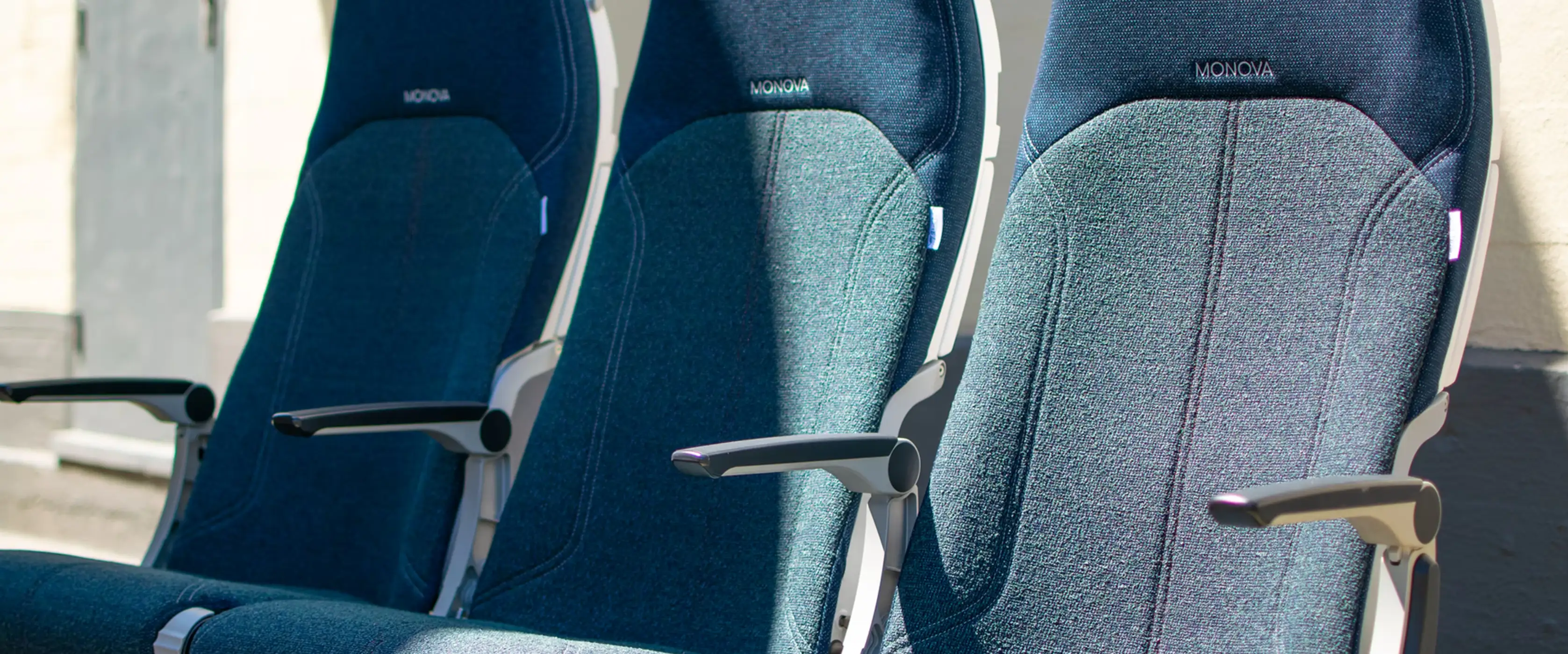
With a background in Transport Design from the UK’s renowned Coventry University, Daniel has spent his career shaping the way passengers experience aircraft interiors. During his time at Acumen Design Associates, he led the design of some of the industry’s most impactful and ground-breaking cabins, including JetBlue’s A321Neo and its reimagined Mint Suite. He has worked with a global portfolio of airlines, including United, Delta and Etihad, and his innovative thinking has led to seven named patents, including RECARO’s first-ever flatbed business class seat, the CL3710. Daniel and his partner, Isabella, founded Studio ID in 2023 and continue to redefine what responsible yet immersive interior design can look like. In a short time, they developed the entire cabin for Cosmic’s all-electric Skylark aircraft and reinvented the dress cover with Monova, resulting in a product designed to be better for passengers and the planet. Daniel also serves on the Leadership Board of the Green Cabin Alliance, helping shape the interior industry’s path towards more circular and environmentally responsible cabins.