Understanding CIE *L *a *b Color Space
CIE *L*A*B COLOR SPACE
Because one person’s view of color may differ from others, visual color matching is extremely subjective. Xrite (1997), a manufacturer of spectrophotometers explains “This can lead to confusion and frustration between customers, suppliers,vendors, production, and management.” CIE Lab Color Space can be used to measure color quantitatively.
Since Isaac Newton discovered that white light contained all the colors of the spectrum in 1666 (Beretta, G. pg. 17), people have been trying to adequately describe color in a quantifiable and reproducible way. Light moves as a wave, with wavelengths from 360-750 nanometers visible to the naked eye. When we see something as a certain color, what we are actually seeing are the reflected colors that are not absorbed by the object.

Figure 1:
How does this work? Let us take, for example, three common colors: John Deere Green, Candy Apple Red, and Kodak Yellow. You have likely seen these colors before and can picture them in your mind. When we shine light on something, it reflects some of it back. The mixture of wavelengths it reflects and the strength of that reflection is plotted as a spectral curve. Figure 1 shows the spectral curve (as a reflected percentage) of these three colors under cool white fluorescent light.
The two major factors in how we see color are the lighting source and the quality of the viewer’s color vision. The lighting source can radically affect the appearance of a color sample. Although two samples may appear to be the same color under sunlight, putting them under fluorescent light may make them look significantly different. This difference between samples under different lighting sources is called metamerism, which can lead to problems in color matching. If we make a color match in the *L*a*b under fluorescent lighting and the customer compares those colors by an office window it may look like a poor match.
In this case, we lack both a standard observer and a standard light source, and we are comparing apples to oranges. To eliminate such discrepancies CIE *L*a*b Color Space was developed to standardize and quantify objectively how we measure a color.
Colors are measured in the CIE La*b system with a standard illuminant; the most common
being CWF2 – Cool White Fluorescent (such as used in an office building), and D65 – Daylight.
These standards are the same anywhere in the world, and are independent of local conditions.
They are traceable back to a known standard, and calibrated regularly.
CIE *L*A*B COLOR SPACE
With standardization of the lighting source the most subjective of part of the equation is still left open that of the standard observer. In the CIE *L*a*b Color Space color is measured electronically, not with the human eye. The machine, called a spectrophotometer, reads the color and records the spectral data. Since this machine is calibrated with a standard, all spectrophotometer readings can be compared regardless of who took them or when. Using this data, the machine mathematically derives the color’s position in the CIE *L*a*b color space.
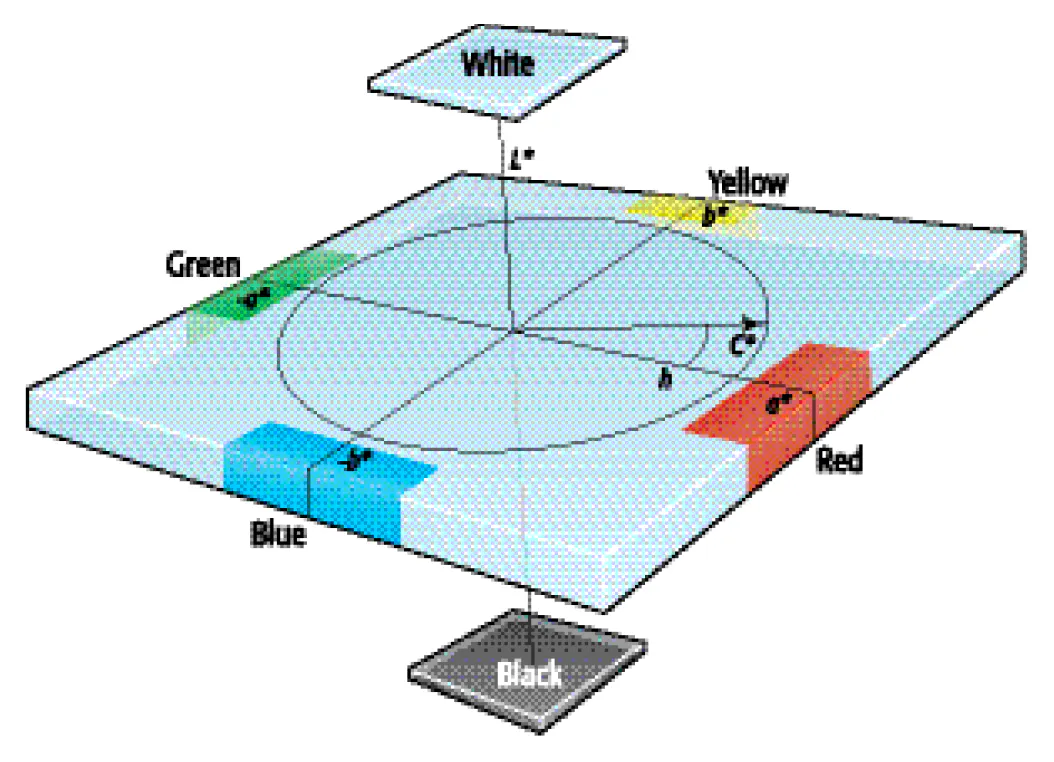
Figure 2:
INTERPRETATION OF THE CIE *L*A*B COLOR SPACE
CIE *L*a*b envisions a three dimensional space, with three axes, represented in Figure 2 (Eye-Color. 2002)
*L is the light and dark axis. It can be thought of as the average value of a spectral curve, with 0 representing no reflection (black) and 100 representing high reflection (white).
*a is the red and green axis. A positive *a value indicates a color is red. A negative value indicates green.
*b is the yellow to blue axis. A positive *b value indicates a color is yellow. A negative value indicates blue.
Taken together, these three numbers represent a particular color that can be compared anywhere in the world. Our three common colors under CWF2 using the CIE *L*a*b Color Space yield the results shown below.
| *L | *a | *b | |
|---|---|---|---|
| John Deere Green | 44.48 | -18.62 | 22.33 |
| Candy Apple Red | 46.68 | 37.06 | 32.77 |
| Kodak Yellow | 82.61 | 14.63 | 80.45 |
After establishing standards for a given color, we can then begin to compare them. On page
INTERPRETATION OF THE CIE *L*A*B COLOR SPACE
After establishing standards for a given color, we can then begin to compare them. Below, in Figure 3 are spectral data from a production lot compared to a standard.

Figure 3:
USING CIE *L*A*B
Using the CIE*L*a*b system we can look at the *L*a*b values and calculate the differences as seen below. Since we can quantify the standard, the production lot, and the difference, we have a reference to communicate, and ensure the quality of the color. In this case, the Production Lot is slightly lighter, less red, and more yellow than our standard. These differences are called deltas. Derived from these deltas is another measure called Delta E, which signifies the overall color difference.
| *L | *a | *b | |
|---|---|---|---|
| Kodak Yellow | 82.61 | 14.63 | 80.45 |
| Production Lot | 82.11 | 14.11 | 81.57 |
| Difference | 0.5 | -0.53 | 1.11 |
REFERENCES
Xrite. (1997). A guide to Understanding Color Tolerancing, L10-024.pdf retrieved online February 24, 2003
Beretta, Giordano. (2000). Understanding Color, UnderstandColor.pdf retrieved online February 24, 2003
Eye-Color. (2002). Color Spaces, CIELab_65percent.jpg retrieved online February 24, 2003
Because we cannot anticipate or control the many different conditions under which this information and our products may be used, we do not guarantee the applicability of the accuracy of this information or the suitability of our products in any given situation. Users should conduct their own tests to determine the suitability of each product for their particular purposes. Data in the physical property table represents typical values and are to serve only as a guide for engineering design. Results are obtained from specimens under ideal laboratory conditions. Right to change physical properties as a result of technical progress is reserved. THE PRODUCTS DISCUSSED ARE SOLD WITHOUT WARRANTY OF MERCHANTABILITY OR FITNESS FOR A PARTICULAR USE, EITHER EXPRESSED OR IMPLIED, EXCEPT AS PROVIDED IN OUR STANDARD TERMS AND CONDITIONS OF SALE. Buyer assumes all responsibility for loss or damage arising from the handling and use of our products, whether done in accordance with directions or not. In no event shall the supplier or the manufacturer be liable for incidental or consequential damages. Also, statements concerning the possible use of our products are not intended as recommendations to use our products in the infringement of any patent. Consult local code and regulatory agencies for specific requirements regarding code compliance, transporting, processing, recycling and disposal of our product. Product not intended for use as a heat resistant surface. Texture, product grade and other conditions may cause variations in appearance.
This information supersedes all previously published data.